
Luxury Nursery Ideas That Grow With the Child
Designing a nursery is one of the most personal interiors projects in a home. But the most beautiful children's rooms are not necessarily the ones designed only for the first year.
The best luxury nursery ideas consider what happens next.
A cot becomes a bed. Baby clothes disappear from open shelves. Books multiply. Toys become collections. The room slowly changes from a nursery into a child's own space - and thoughtful design allows that transformation to happen without starting again from the beginning.
Rather than building a room around a short-lived theme, consider materials, colours and objects that can remain meaningful for years.
Here are five ideas for creating a nursery designed to grow alongside the child.
1. Begin With a Timeless, Neutral Palette
A neutral nursery does not have to mean an entirely beige room.
The idea is to create a quiet architectural foundation that can accommodate change.
Warm whites, soft stone, muted sage, dusty blue, natural wood and restrained patterns give a room enough character to feel considered without tying it to a particular age.
This is one of the simplest principles of timeless nursery design: let the permanent elements of the room remain calm and introduce personality through things that are easier to change.
Artwork can move. Books change. Textiles can evolve. A favourite colour at four may be completely different at eight. Walls, flooring and substantial furniture should not necessarily have to follow.
For high-end nursery decor, restraint often creates a more sophisticated result than abundance. A limited palette also allows the texture of natural materials - wood, cotton, silk, rattan and metal - to become part of the decoration.
The room feels designed rather than themed. And that distinction matters when longevity is the goal.
2. Choose Natural Materials That Become More Beautiful With Time
Some materials are designed to look perfect on the day they arrive. Others become more interesting as they are lived with.
Wood is one of them.
Little Forest Animals itself began with an interest in architectural design and creates its dollhouses with the intention of making objects that can remain part of family life rather than quickly being replaced.
The same principle works beautifully in a nursery.
Natural timber furniture, woven baskets, cotton textiles and tactile rugs bring warmth into a room without depending on decorative trends.
They also work at different ages.
A woven basket that stores blankets beside a cot may later hold books or toys. A wooden cabinet used for baby clothes can eventually become general storage. A beautifully made rug can move from the nursery to a bedroom, reading corner or playroom.
This is where heirloom nursery objects differ from ordinary children's decor. Their value does not disappear when the child's age changes.
Consider the Floor as Part of the Room
A nursery is experienced from the floor more than almost any other room in the house.
First there are adults sitting beside a baby. Then crawling. Then playing. Then reading, drawing and building entire imaginary worlds on the floor.
A tactile rug therefore has both a visual and spatial role.
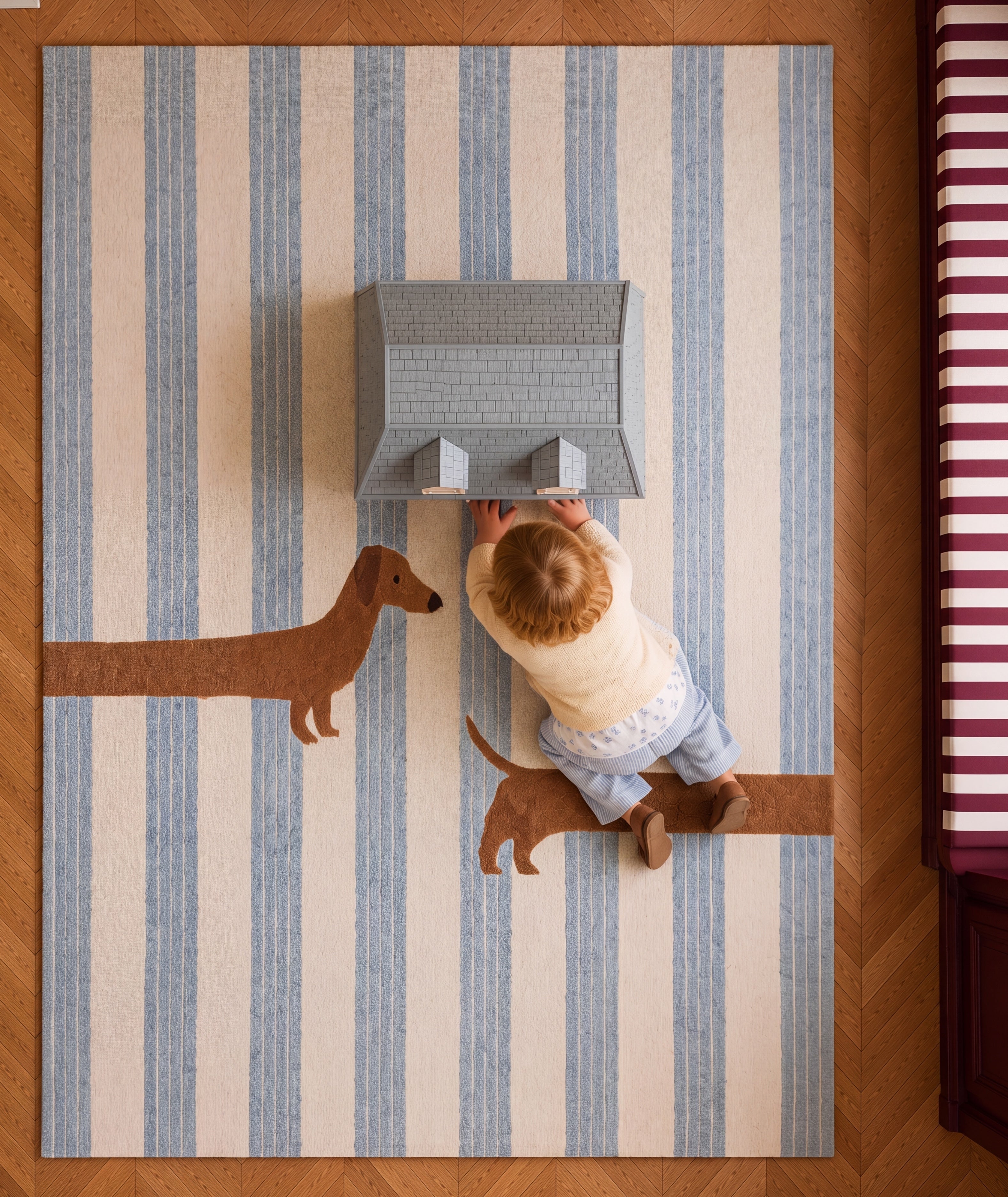
The Little Forest Animals Rug Edit is designed around statement rugs for children's and nursery interiors.
Instead of choosing a rug that announces 'baby', choose one that could still look intentional beneath a desk or beside a larger bed years later.
That single decision can dramatically extend the visual life of the room.
3. Use Lighting as Jewellery for the Room
Lighting is often treated as the final practical decision in a nursery. It should be considered much earlier.
A beautiful room needs layers of light: daylight during the morning, softer ambient light toward evening and small pools of warm light that make shelves and corners feel intimate.
For a luxury nursery, lighting can also function almost like jewellery.
Brass, warm metals and sculptural fixtures introduce a more permanent material language than overtly childlike lamps.
And miniature lighting can create an entirely different effect.
Little Forest Animals' lighting world includes rechargeable LED systems and miniature premium lighting. Used inside a dollhouse, those small points of light transform it after dark.
Suddenly the object sitting quietly in the room during the day becomes an illuminated miniature interior in the evening.
Discover miniature dollhouse lighting designed to make every tiny room glow after dark.
That creates one of the most interesting opportunities in children's interiors: an object can simultaneously be lighting, architecture, play and decoration.
4. Think of the Dollhouse as Decor - Not Something to Hide Away
Toy storage usually begins with one assumption: when playtime ends, everything should disappear.
But what if the object itself is beautiful enough to remain in the room?
This is where the idea of dollhouse as decor becomes particularly relevant to a luxury nursery.
A carefully designed wooden dollhouse does not necessarily need to live inside a toy cupboard. It can become part of the architecture of the room - positioned beneath artwork, beside a bookcase or against a wall in the same way one might place a small cabinet.
The difference becomes even clearer with larger architectural houses.
Little Forest Animals houses such as the House of New York and House of Monaco are substantial architectural objects within an interior, designed with detailed rooms and fully considered miniature worlds.
A dollhouse does not have to visually expire when childhood does.
At three, it may be a world for storytelling. At eight, its interiors may be constantly rearranged. Later, it can remain on a shelf or console simply because the architecture is beautiful. Eventually, it may become something kept for another generation.
This is the difference between filling a nursery with children's products and furnishing it with objects that happen to belong beautifully in childhood.
5. Style Shelves With Objects That Tell a Story
The best nursery shelves are rarely the most crowded ones.
Think instead about shelfie styling as a small composition.
A few beautiful books. A framed photograph. A wooden animal. A miniature lamp. A treasured object from a grandparent. Perhaps one toy that is particularly beautiful.
Leave space between them.
Children's rooms naturally accumulate objects over time, so beginning with some visual breathing room allows the collection to grow organically.
More importantly, resist the temptation to make every object conform to a single nursery theme.
A room becomes more personal when its objects arrive at different moments.
The book received at birth. The wooden toy from a first birthday. The object brought home from a family trip. The dollhouse chosen a few years later.
Over time, the shelf becomes less like styling and more like biography.
That is difficult to achieve by buying an entire room at once.
What Makes a Nursery Truly Luxurious?
Luxury in a child's room is easy to misunderstand.
It is not simply a question of price. Nor is it about filling every available surface.
The most convincing high-end nursery decor often comes from fewer, better decisions: natural materials, beautiful craftsmanship, thoughtful lighting and objects that do not need to be discarded as the child grows.
Longevity itself becomes a form of luxury.
A rug that survives several versions of the room. A wooden object that develops a history. A dollhouse that moves from nursery to bedroom and perhaps, decades later, into another child's room.
That philosophy applies just as naturally to the room around them.
A Room That Changes Without Losing Its Story
Perhaps the most useful question when designing a nursery is not: What will look beautiful when the baby arrives?
It is: What will still feel beautiful five or ten years from now?
Choose the quiet wall colour. Invest in natural materials. Let a hand-tufted rug anchor the room rather than define its age. Use brass and warm lighting to introduce depth. Style shelves gradually. And make room for a few extraordinary objects that are allowed to remain visible.
The result is not simply a beautiful nursery. It is a room with somewhere to go.
Because the most successful luxury nursery ideas are not designed for one photograph, one age or one moment.
They are designed to become part of childhood.

FAQ: Luxury Nursery Design
How do you design a luxury nursery that won't date quickly?
Begin with a restrained colour palette and natural materials for the permanent elements of the room. Personality can then come from artwork, books, textiles and smaller decorative objects that are easier to change as the child grows.
What colours work best for a timeless nursery?
Warm whites, stone, muted greens, dusty blues and natural wood tones provide a versatile foundation. The objective is not necessarily to create a completely neutral room, but to avoid making the largest surfaces dependent on a short-lived trend.
What should you invest in for a high-end nursery?
Prioritise objects with longevity: well-made furniture, natural materials, a quality rug, thoughtful lighting and decorative pieces that can remain relevant beyond the baby years.
Can a dollhouse be used as nursery decor?
Yes. An architectural wooden dollhouse can function as both a play object and a decorative feature. Larger designs can be styled beside shelving, beneath artwork or as a focal point within the room rather than being hidden after play.
How can a nursery grow with a child?
Keep the room's foundation flexible and allow smaller elements to evolve. Storage can change purpose, artwork can move, shelves can acquire new objects and a nursery rug can later anchor a child's bedroom or reading area.
What are heirloom nursery objects?
Heirloom nursery objects are pieces selected for their craftsmanship, materials, emotional value and ability to remain useful or meaningful beyond a single developmental stage. They may eventually be stored, displayed or passed to another generation.