
Why Wood Matters: The Material Behind a Beautiful Dollhouse
When choosing a dollhouse, architecture and colour may be the first things you notice. But what gives a house its character begins with something more fundamental: the material it is made from.
At Little Forest Animals, we choose wood because it brings together the qualities we value most — substance, warmth, precision, durability, and a natural place within the home.
For us, wood is not simply a material choice. It is where the design begins.
Why Choose a Wooden Dollhouse?
A dollhouse is made to be touched, opened, rearranged, and returned to every day. It needs to feel beautiful, but it also needs to have substance.
Wood gives a dollhouse that balance.
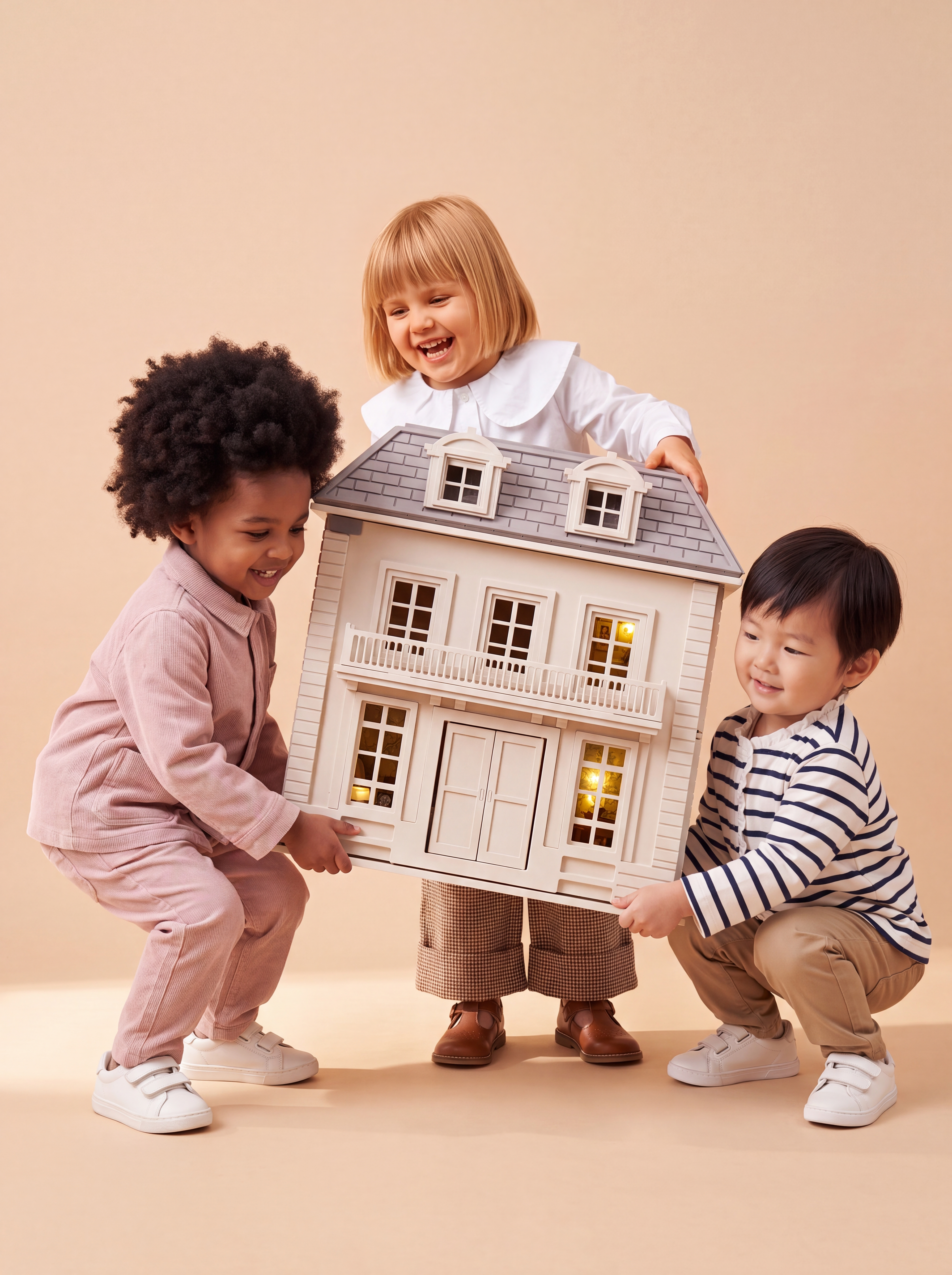
Its weight creates stability. Its surface allows for carefully painted finishes and precise architectural details. Its tactile quality gives children something warm and substantial to interact with.
And visually, wood has a quietness that feels naturally at home alongside furniture, textiles, books, and the other objects we choose to live with.
A wooden dollhouse does not have to feel separate from the room around it. It can simply become part of it.
Wood as a Foundation for Architecture
Our Houses begin with architecture.
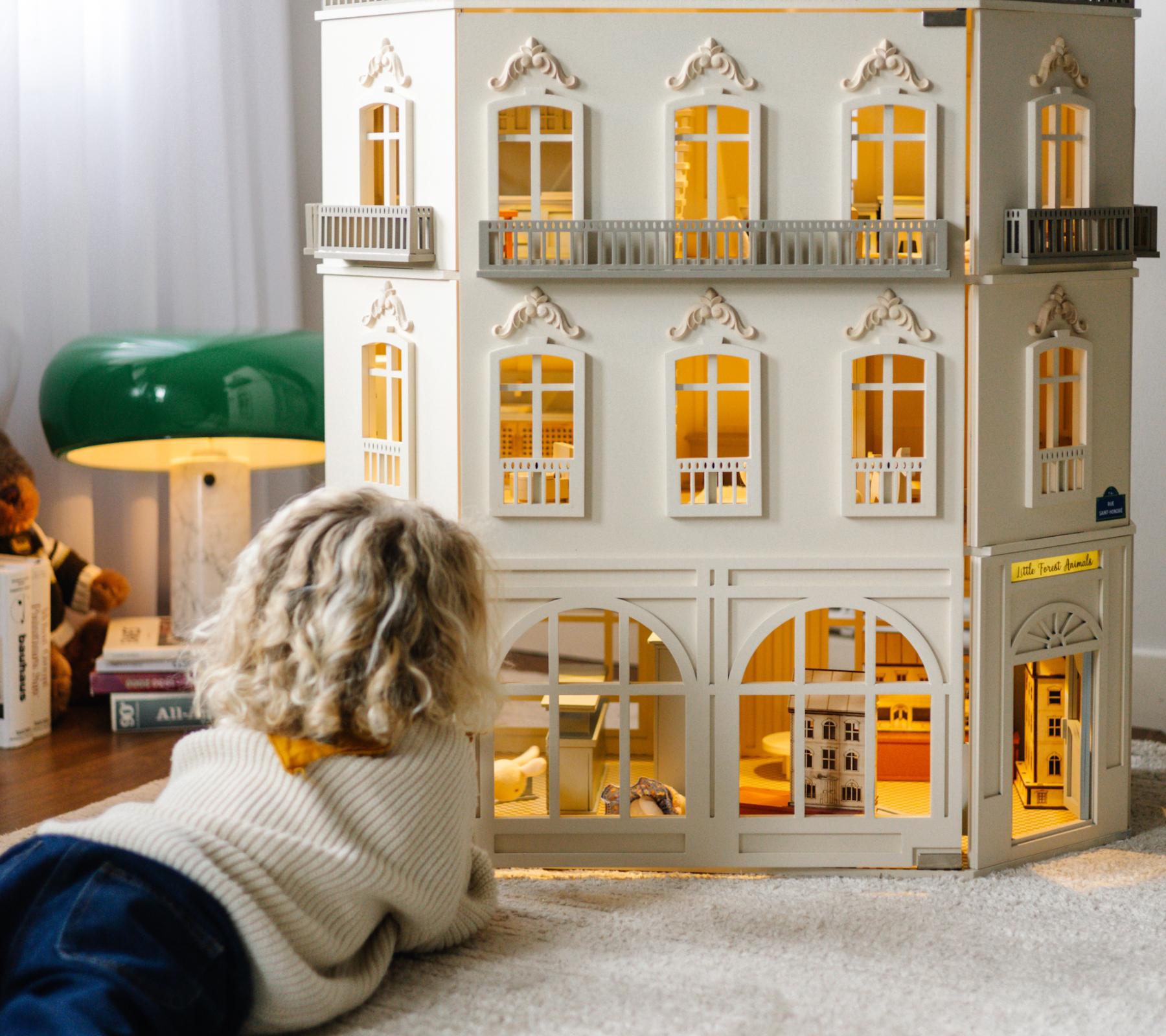
From the mansard-inspired roofline of the House of Paris to the vertical townhouse proportions of the House of London, every model depends on clean lines, balanced proportions, and carefully resolved details.
Wood-based construction gives us the stable foundation needed to express those architectural ideas in miniature.
Walls can feel substantial. Openings can be precisely placed. Staircases, floors, windows, and façades can work together as one coherent structure.
This precision is important because we do not think of a dollhouse as simply a container for play.
We think of it as architecture in miniature.
The Warmth of Wood
There is also an emotional quality to wood.
It feels familiar. Natural. Tactile.
Even when painted, a wooden object retains a sense of substance that changes the way we experience it. There is a softness to its presence — not visually decorative, but quietly reassuring.
This is particularly meaningful in a child’s room, where the objects around them become part of everyday life.
We want our Houses to feel considered without feeling precious; beautiful enough to remain visible, but always made to be played with.
Wood allows those two ideas to exist together.
A Material Made for Detail
The smallest details often define the character of a House.
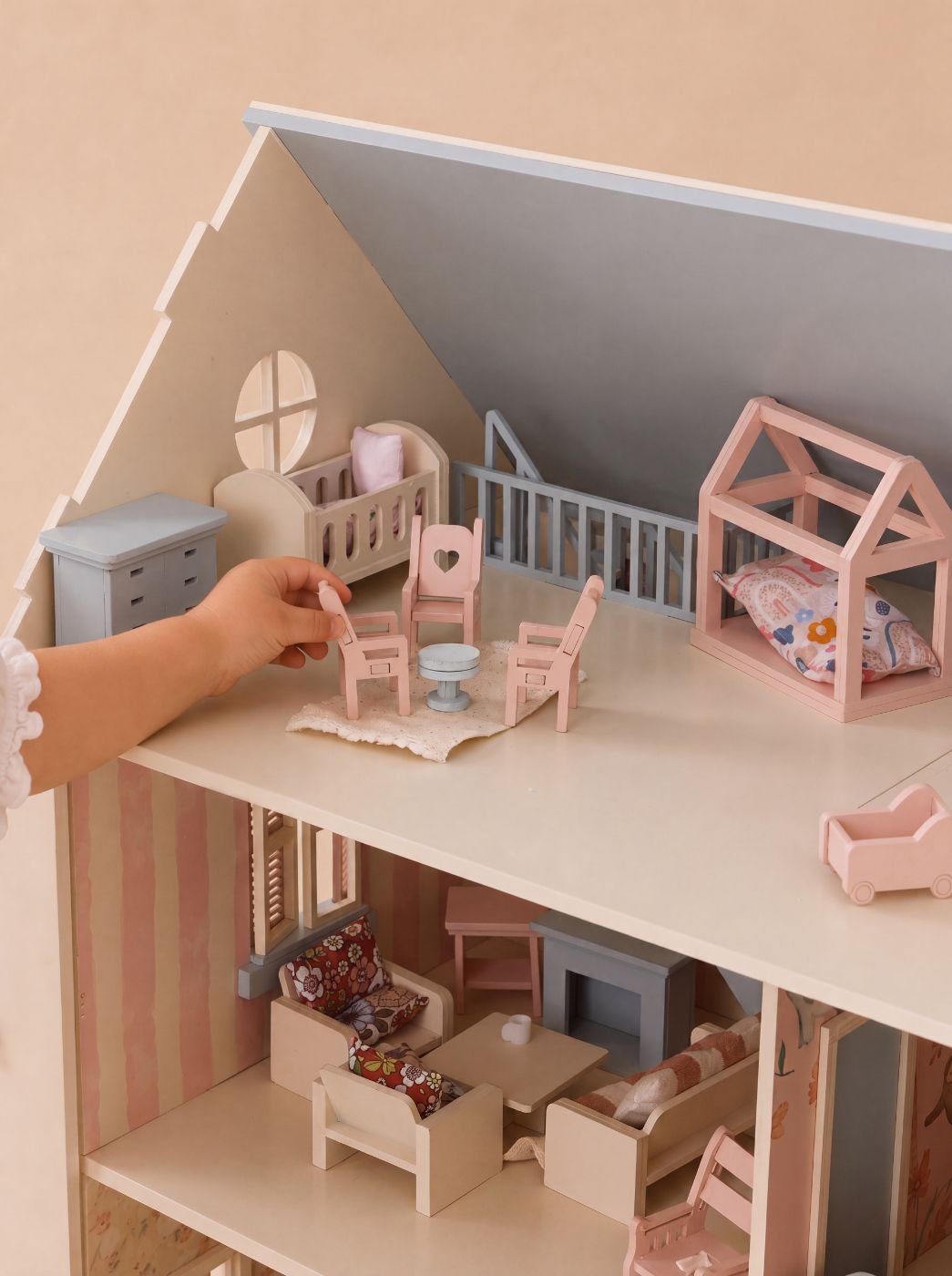
A carefully shaped window. The edge of a staircase. A doorway between two miniature rooms.
The engineered wood we use provides a smooth and stable surface for these details, allowing us to work with architectural forms at a small scale while maintaining clean edges and consistent finishes.
This is one of the reasons material selection matters so much to us.
When the foundation is right, the design does not need to work hard to appear refined. The quality can be felt in the details.
The Beauty of the Finish
Wood also gives us a beautiful surface to work with.
Colour can be layered onto the architecture without overwhelming it. Details remain visible. Interior and exterior surfaces can be considered as part of the same object.
We are drawn to finishes that feel understated: warm tones, restrained palettes, smooth surfaces, and details that reveal themselves gradually.
The intention is never to make the material or finish demand attention.
Instead, everything should feel as though it naturally belongs together.
Made for Hands, Not Only for Rooms
While we think carefully about how our Houses look within an interior, they are first and foremost made for play.
Children experience materials through touch.
They open a door again and again. They move a chair from one floor to another. They run their hands along a staircase and rearrange the same room in a hundred different ways.
Wood brings a physical quality to these small interactions.
Its weight, smoothness, and solidity make the miniature world feel tangible. The architecture is not simply something to look at; it becomes something children can physically inhabit through imagination.
Wood and Longevity
One of the qualities we value most about wood is its relationship with time.
A wooden object does not need to remain untouched to remain beautiful.
It can be lived with.
A small mark may appear. A painted surface may eventually need attention. Hardware may require adjustment after years of use.
Depending on its construction, a wooden piece can often be maintained, refreshed, and repaired rather than immediately replaced.
For an object designed to accompany childhood, this matters.
We are less interested in creating something that looks perfect forever than in creating something that can continue beautifully through use.
Designed to Be Kept
This is also why wood feels particularly appropriate for an object intended to stay in the family.
A well-made wooden dollhouse can move through different chapters of childhood. Rooms change. Doll Families arrive. Lighting is added slowly. A younger sibling may eventually begin playing with the same House.
Over time, the object becomes familiar.
Its value begins with design and craftsmanship, but eventually comes from something much more personal: the memories attached to it.
This is what we mean when we talk about creating something to keep.
Not an object that must be preserved untouched, but one that is made well enough to be lived with.
A Considered Approach to Materials
Choosing wood does not mean that every wooden object is automatically better.
The quality of the material, construction, finishes, craftsmanship, and safety considerations all matter.
This is why we look beyond the simple label of “wooden dollhouse.”
We consider how the material supports the architecture, how surfaces are finished, how components come together, and how the House will respond to years of play.
Good material choice is not about using wood for the sake of saying something is made from wood.
It is about using wood because it is the right material for the object we want to create.
Wood and a Longer Life
Material choice is also part of how we think about responsible design.
Sustainability is more complex than choosing one material over another. Sourcing, manufacturing, finishes, transportation, repairability, and product lifespan all play a role.
But longevity matters.
When something is thoughtfully made, cared for, repaired when necessary, shared between children, and kept rather than frequently replaced, its relationship with consumption changes.
Our approach begins with a simple idea:
Make fewer things. Make them thoughtfully. Make them worth keeping.
Wood supports that philosophy beautifully.
What to Look for in a Wooden Dollhouse
Not all wooden dollhouses are made in the same way.
Look beyond the material description and consider the entire object.
The structure should feel stable and substantial. Edges and corners should be carefully finished. Painted surfaces should feel consistent. Architectural elements should align naturally, and moving parts should feel integrated into the design.
Look inside, too.
A thoughtfully made House should receive the same attention on its interior surfaces as it does on its façade.
The difference is often found in details that are easy to overlook at first — and difficult not to notice once you begin living with the object.