
A Dollhouse at Three: Where Imagination Meets the Real World
A Dollhouse at Three: Where Imagination Meets the Real World
Three is a fascinating age.
A child is beginning to understand that the world around them has patterns. Mornings have routines. Families gather around tables. Someone prepares dinner. Someone goes to sleep. Doors open into rooms, objects have places, and the people around them each have roles.
And then, slowly, children begin to recreate these observations through play.
A dollhouse can become particularly meaningful at this stage — not because three is a perfect age printed on a box, but because the idea of home is beginning to become something a child can explore through imagination.
At Little Forest Animals, this is how we think about a first dollhouse: not simply as a collection of rooms and miniature furniture, but as a small world through which children can begin to interpret the larger one around them.
At Three, the Real World Becomes a Story
Young children learn through observation long before they can explain everything they understand.
They notice where people sit.
They understand that a bed belongs in a bedroom and that dinner happens around a table. They recognise familiar routines, relationships, gestures, and emotions.
Then something wonderful begins to happen.
They recreate them.
A doll goes to sleep. Another prepares breakfast. Someone leaves the House and comes home again. A chair moves because a guest is arriving.
These may appear to be very simple stories to an adult.
For a child, they are a way of taking something observed in the real world and making it their own.
A Small World They Can Understand
The real world is enormous when you are three.
A house is large. Furniture is large. Adults make decisions. Most objects have rules about how they can be used.
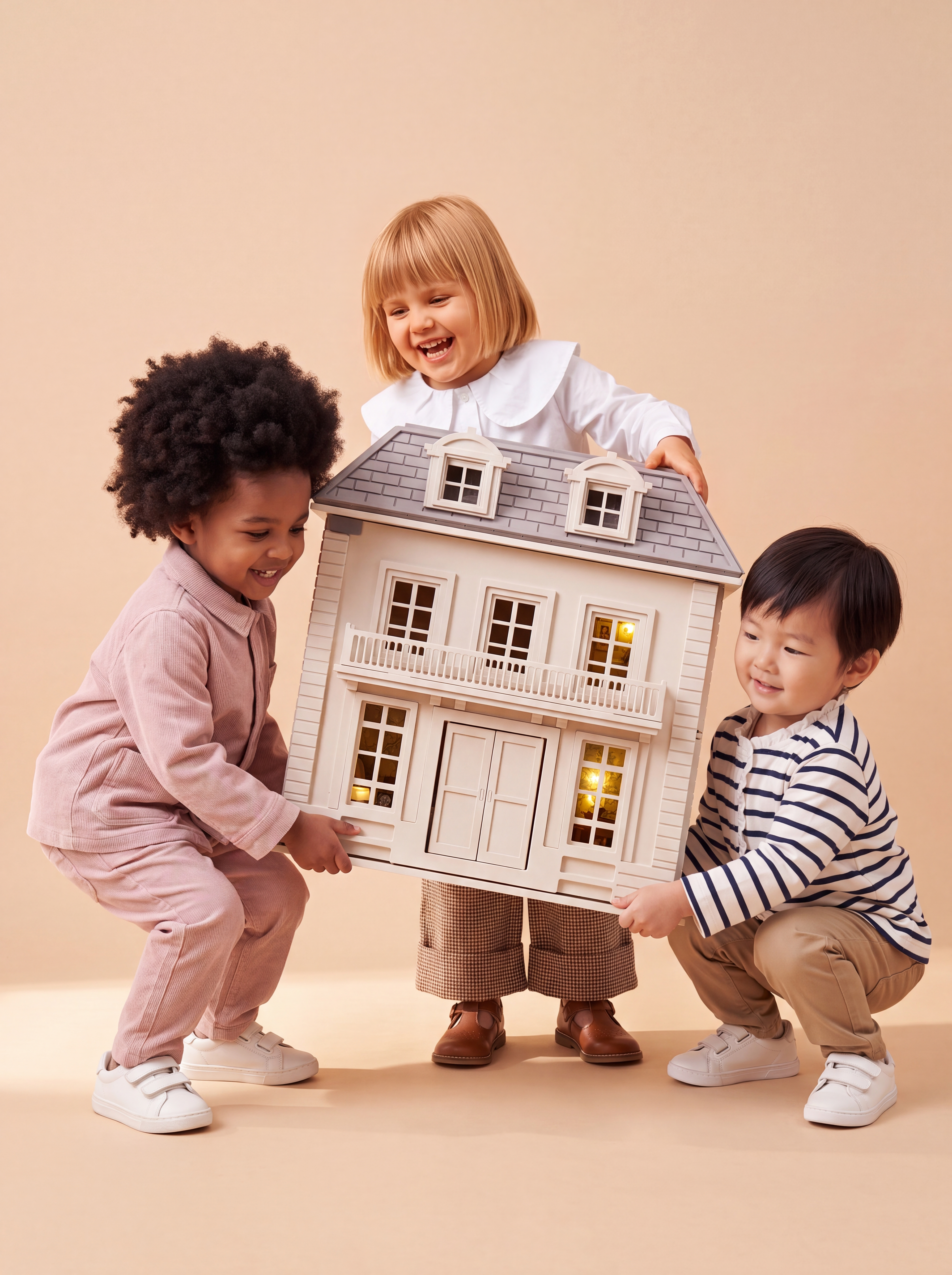
A dollhouse changes the scale.
Suddenly, the child can see the entire home at once.
They can move the bed. Decide who sits at the table. Put the Doll Family to sleep. Change the living room. Move everyone upstairs. Begin the morning again.
The familiar world has become small enough to hold.
This is part of what makes miniature play so compelling: reality remains recognisable, but the child is free to rearrange it.
Trying Out Who We Are
At around this age, pretend play also begins to become increasingly social and narrative.
Children imitate the people around them, but they do not simply copy what they see. They experiment with it.
In play, a child can become the parent, the child, the visitor, the cook, the storyteller — sometimes all within a few minutes.
Through these little stories, they can explore relationships and perspectives from different positions.
A dollhouse offers a setting for this naturally.
There is no script telling the child what should happen next. The House provides the architecture; the child gives it life.
For us, this freedom is essential.
The purpose is not to teach a child what a family or a home should look like. It is to give them enough of a familiar world to begin creating their own.
Reality, Made Small
This is also why realism matters to us.
Our Houses are inspired by real architecture. A staircase leads somewhere. A window belongs within a façade. A dining table has a relationship to the chairs around it. Rooms have proportions that make sense.
We do not pursue realism because children's play needs to imitate adult life perfectly.
Quite the opposite.
Reality provides the starting point. Imagination decides what happens next.
When the miniature world contains recognisable references, children can begin with something they already understand and transform it through play.
A bedroom can become a restaurant tomorrow.
The staircase can become the setting for an adventure.
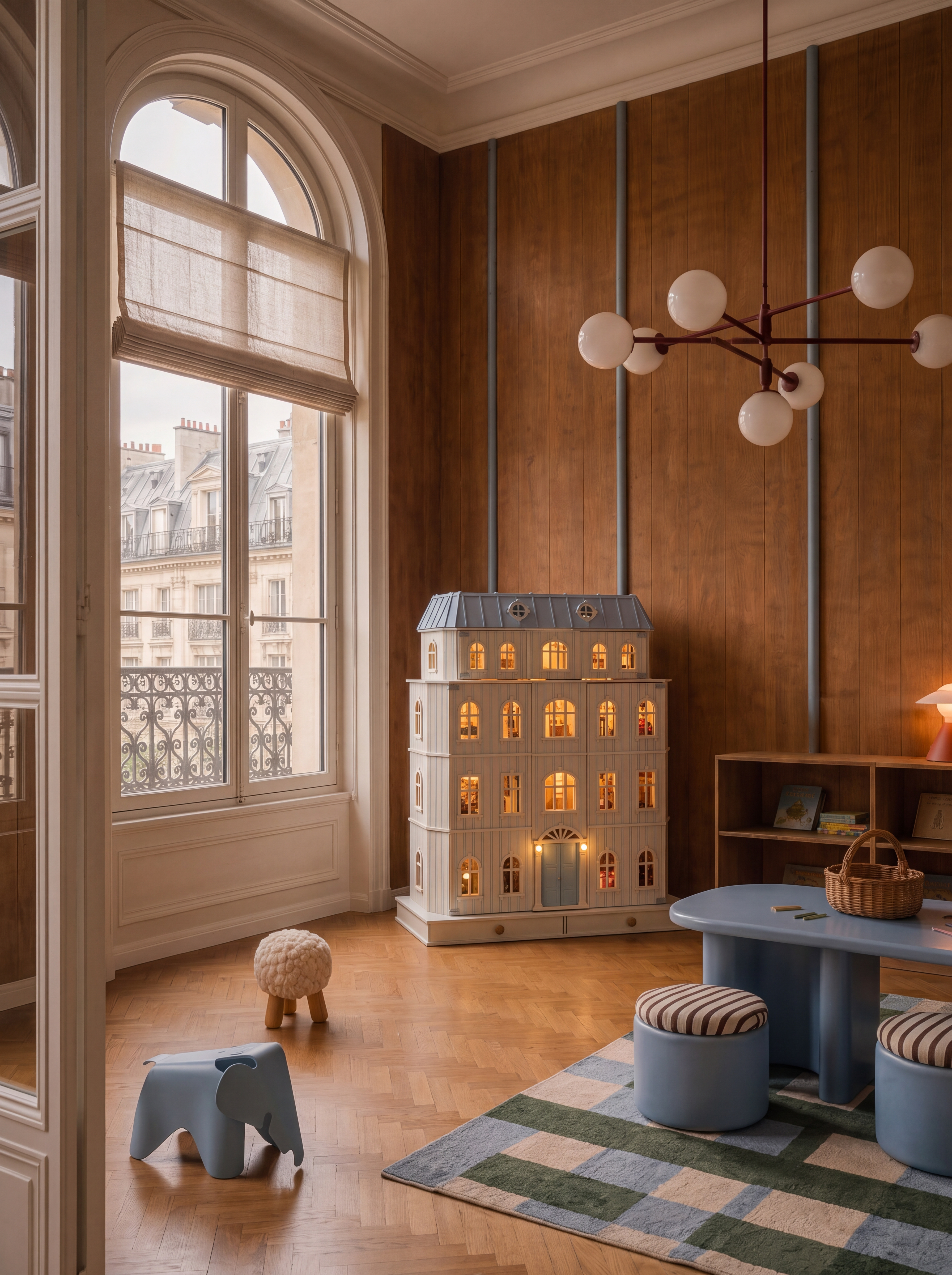
The House of Paris can become home to the Thompsons, the Bellevues, or an entirely imagined family with an entirely imagined life.
Architecture creates the world. Play makes it limitless.
Why Open-Ended Play Matters
At three, we believe less can often offer more.
A button generally has one intended action. A predetermined sound always makes the same sound. A scripted feature suggests what should happen.
An open room asks a different question:
What happens here?
A chair can belong at the dining table, beside a bed, or outside the front door.
A doll can be a parent in one story and a visitor in the next.
The same House can contain hundreds of different narratives without physically changing at all.
This is why we are drawn to open-ended objects.
Rather than filling every moment of play with stimulation, they leave room for the child to contribute something of their own.
And that space is where imagination enters.
The Importance of Familiar Details
A three-year-old does not need an elaborate miniature interior to begin playing.
Often, a few recognisable objects are enough.
A bed suggests sleep.
A table creates a place to gather.
A chair invites someone to sit.
A lamp belongs beside something.
A staircase connects one part of the story to another.
These familiar references help a child enter the miniature world without determining what the story must become.
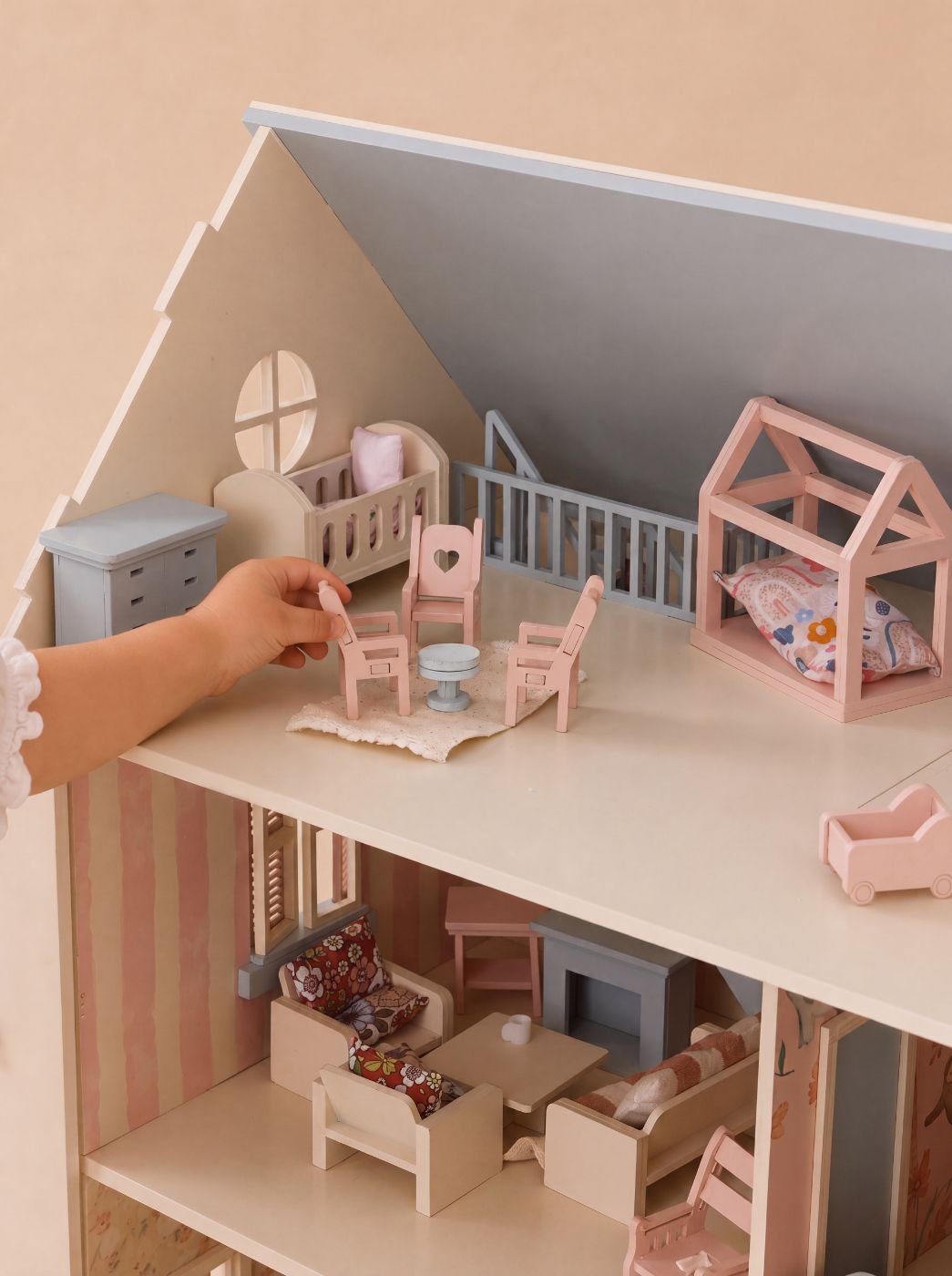
For a first House, we like the idea of creating just enough context for play to begin naturally — a Doll Family, a few pieces of furniture, and rooms waiting to acquire their own meaning.
The collection can grow later, just as a real home does.
A House That Grows with Their Imagination
The stories of a three-year-old are not the stories of a five-year-old.
At first, play may be beautifully simple.
Someone sleeps.
Someone eats.
Someone goes upstairs.
Someone comes home.
As language, imagination, and social understanding develop, those stories can become longer and more intricate. Characters acquire personalities. Relationships appear. Yesterday's story continues tomorrow.
The physical House can remain the same while the world created inside it becomes increasingly complex.
This is one of the qualities we value most in open-ended play: the object does not need to become more complicated because the child does.
The First Dollhouse Should Feel Like an Invitation
For a first dollhouse, we prefer a world that feels approachable rather than overwhelming.
A completely empty House can be wonderfully open-ended, particularly for an older child. At three, however, a small number of familiar elements can make entering the story easier.
A Doll Family — perhaps the Thompsons or the Bellevues — gives the House its first characters.
A bed creates the possibility of bedtime.
A table creates the possibility of breakfast.
From there, the child takes over.
This is why a thoughtfully furnished starting point can work beautifully at this age. Not because every room needs to be complete, but because a few carefully chosen pieces provide the first vocabulary of play.
After that, there is no correct arrangement.
Materials Matter at This Age
At three, children experience objects physically as much as visually.
They feel weight and texture. They open the same door repeatedly. They move furniture from floor to floor. They explore an object through their hands.
This is one reason wood is so important to the way we design at Little Forest Animals.
Its weight gives a House stability. Its smoothness makes it tactile. Its substance gives miniature architecture a physical presence.
For a child, these qualities make the imaginary world tangible.
For the home, they allow the House to exist as something quieter: an object made for play that can still sit naturally alongside furniture, books, textiles, and the rest of the room.
Safety Comes Before the Story
However beautiful the design or meaningful the play, suitability for the individual child always comes first.
Age recommendations should be taken seriously, particularly when a House includes small furniture, accessories, lighting, or other miniature elements.
Parents should consider not only the child receiving the House, but everyone who may have access to it. A younger sibling can change what is appropriate to keep within reach.
Check the manufacturer's stated age recommendations, product safety information, materials, finishes, construction, and guidance concerning small parts.
A first dollhouse should invite independence in play without asking a child to manage objects they are not yet ready to use safely.
Choosing a First Dollhouse
When choosing a dollhouse around the age of three, we would look beyond the number of features.
Instead, consider the world it makes possible.
Is the architecture understandable without dictating the story?
Are there familiar objects a child can recognise and reinterpret?
Can furniture and dolls move freely?
Is there room for the child's imagination rather than only the designer's?
Does the construction feel substantial enough for everyday play?
And perhaps most importantly:
Can this House become something different as the child grows?
A beautiful first dollhouse should not only meet a child where they are today. It should leave enough space for who they are becoming.
Frequently Asked Questions
Is three a good age for a first dollhouse?
Three can be a wonderful age to introduce dollhouse play, as many children are beginning to engage more deeply in pretend play and recreate familiar routines through stories.
Development varies considerably between children, however, so always follow the specific product's age recommendation and consider the child's individual stage of development.
Why is dollhouse play meaningful at this age?
A dollhouse gives children a small, manageable setting in which familiar experiences can be recreated and transformed.
Everyday ideas — sleeping, eating together, leaving home, returning, caring for someone — can become the beginnings of imaginative stories.
Can a dollhouse support a child's developing sense of self?
Pretend play gives children opportunities to experiment with roles, relationships, perspectives, and familiar experiences.
Rather than seeing a dollhouse as something that forms a child's identity, we prefer to think of it as a space where children are free to explore their understanding of themselves and the people around them.
Should a first dollhouse be furnished?
A few familiar pieces can make a first House easier to enter imaginatively.
A bed, table, chairs, and a Doll Family such as the Thompsons or the Bellevues provide recognisable references without determining the story. Additional furniture and objects can then be introduced gradually as the child's miniature world grows.
What should I consider for a three-year-old?
Begin with safety and the manufacturer's age recommendation. Consider small parts, construction, materials, finishes, stability, and whether younger children have access to the play area.
After that, look for simplicity, tactility, familiar details, and enough openness for the child to decide what happens next.
A Small Place to Make Sense of a Big World
At three, the world is becoming increasingly familiar — but there is still so much of it to understand.
Through play, children can take pieces of that world and rearrange them.
They can repeat what they know, change what they have seen, invent what does not exist, and begin again whenever they choose.
Perhaps this is why a dollhouse can become such a meaningful object at this age.
It makes the world small enough to hold, while leaving the imagination enough room to make it infinite.
A real little House. An entirely imagined world.