
The Real Benefits of Dollhouse Play
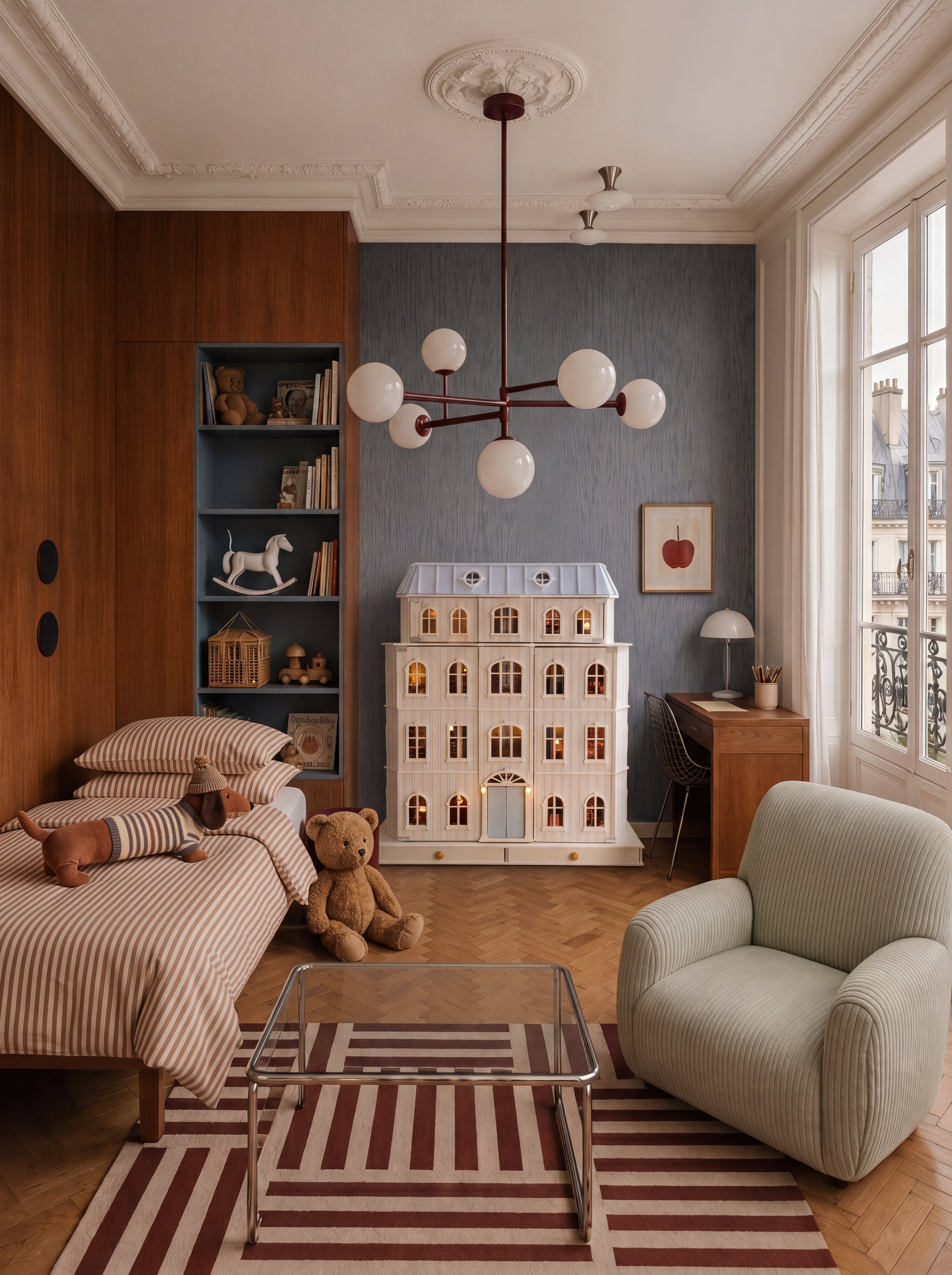
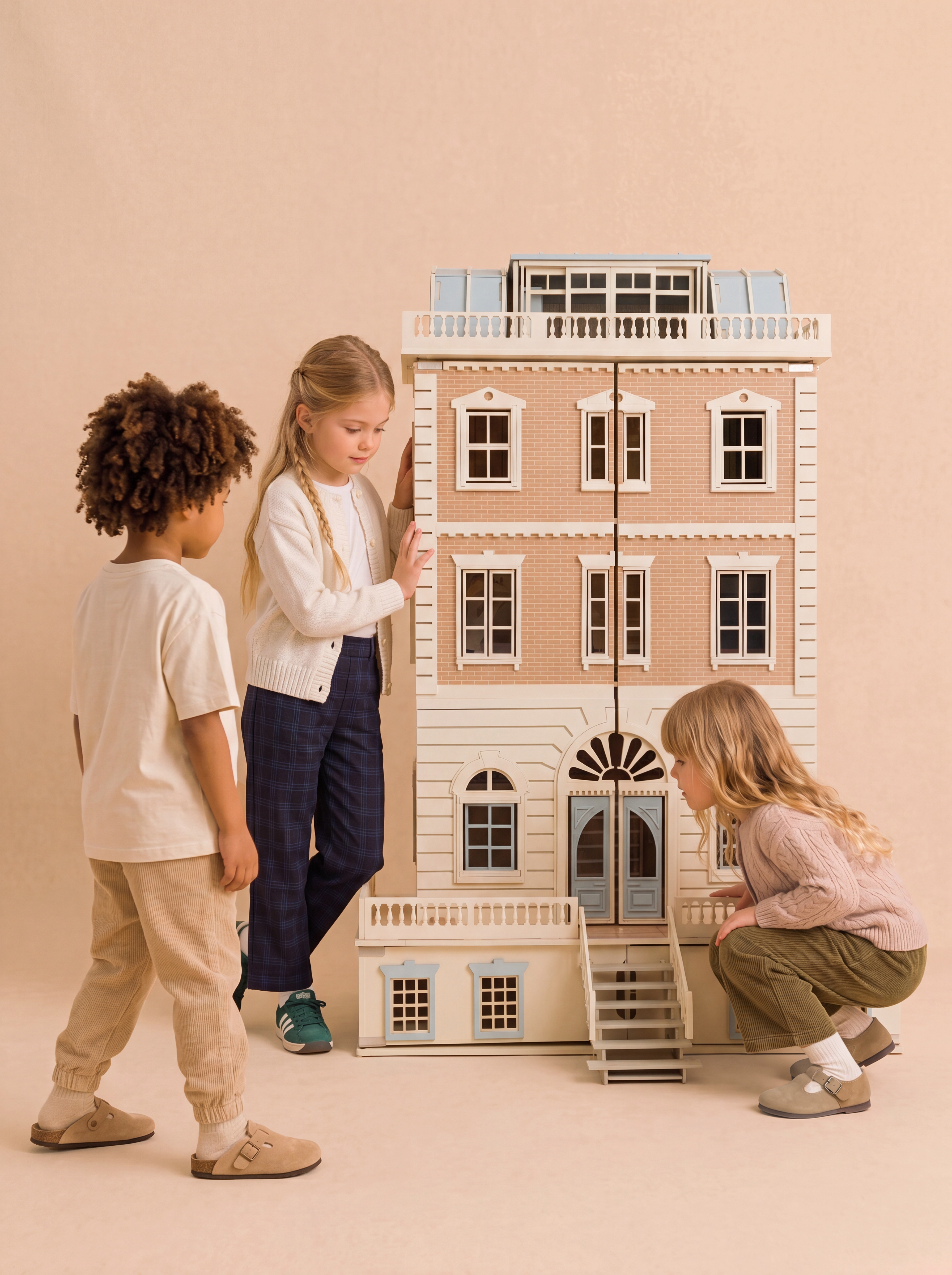
A dollhouse looks like a small house. In play, it can become almost anything.
Breakfast can turn into a birthday party. A bedroom can become a school. An animal family can move from Paris to New York before lunch. A child can repeat the same story for a week, abandon it, and return with an entirely different idea.
That flexibility is central to understanding the benefits of dollhouse play.
Dollhouse play brings together several familiar forms of childhood play: imaginative play, role play, object manipulation, storytelling and open-ended play. Research does not justify claiming that a dollhouse uniquely causes children to become more creative, social or cognitively advanced. In fact, a major review of pretend-play research specifically warns against strong causal claims.
What we can say is more useful: a dollhouse creates a rich setting in which children can practise stories, relationships, language, movement and sustained imaginative activity.
That is valuable without needing to turn play into medicine.
1. Dollhouse Play Is Naturally Open-Ended
Some toys tell children exactly what to do next. A dollhouse does not.
There is no final level to complete, no single correct arrangement and no prescribed ending. Furniture can move. Characters can change roles. Rooms can acquire new purposes.
This is what makes dollhouse play a form of open-ended play.
The architecture provides enough structure to begin — a kitchen, staircase, bedroom or shop — while leaving the narrative to the child.
That balance matters. Too little structure can make it difficult to begin; too much can make the play feel predetermined. A miniature home sits somewhere in between.
At Little Forest Animals, this is one reason our houses are detailed but not narratively fixed. The rooms offer possibilities rather than instructions.
Discover more ideas for creating a world where imagination can lead the way. 
2. Imaginative Play Turns Objects Into Stories
Pretend play involves treating something as more than its literal reality. A miniature cup can contain imaginary tea. An animal can become a parent, neighbour, doctor or shopkeeper. A room can represent somewhere entirely different.
Developmental researchers describe pretend play as involving nonliteral or symbolic relationships. Research has explored links between this kind of play and language, theory of mind and counterfactual thinking, although the strength and direction of those relationships should not be overstated.
For parents, the practical observation is simpler: dollhouses give children a physical stage for imagination.
Instead of imagining an entire world without objects, children can use rooms, furniture and characters as anchors for the story.
That can make complex pretend scenarios easier to build, revisit and change.
3. Storytelling Creates Natural Opportunities for Language
Dollhouse play is often full of words.
A child names characters, decides what happened yesterday, explains where somebody is going, invents dialogue and narrates events. When two children play together, they may also need to explain their ideas to each other.
Research reviews have examined associations between pretend play, language and narrative development. However, the evidence does not establish that pretend play alone causes stronger language development; a widely cited review concluded that the evidence was compatible with several explanations.
That distinction is important.
We do not need to promise a developmental outcome to recognise that storytelling creates opportunities to use language.
A child saying, “The rabbit is going upstairs because she forgot her bag,” is simultaneously playing and constructing a small narrative involving a character, action, place and reason.
The dollhouse simply gives that sentence somewhere to happen.
4. Role Play Lets Children Explore Different Perspectives
Who lives here? Who is visiting? Who is upset? Who gets the upstairs bedroom?
Role play naturally asks children to assign intentions, feelings and relationships to characters.
Pretend play has long been studied alongside children's understanding of other minds and social cognition. The evidence is nuanced: researchers have proposed meaningful theoretical connections, but strong claims that pretend play directly produces empathy or theory-of-mind development go beyond what the evidence can firmly establish.
A more careful way to describe the value is that role play offers repeated opportunities for perspective-taking.
A child can decide what one character knows that another does not, how a family member might react, or why two characters disagree.
With animal families, those roles remain particularly open. The characters can acquire whatever personalities and relationships the child imagines.

5. Playing Together Requires a Shared Imaginary World
Solo dollhouse play and shared dollhouse play are different experiences.
When children pretend together, the imaginary situation has to become at least partly shared. If one child says the kitchen is now a restaurant, the other child has to understand the new premise for the story to continue.
Recent developmental work describes shared pretense as involving jointly created social contexts with rules that exist because the players agree to them.
In everyday terms, children negotiate.
Who is this character? What are we pretending? Can the rabbit sleep here? Is this room a shop now?
Those exchanges can create natural opportunities for conversation, turn-taking, disagreement and compromise.
Again, the dollhouse is not a guaranteed social-skills intervention. It is a setting in which social play can happen.
6. Small Objects Invite Fine-Motor Interaction
Dollhouse play is physical at a very small scale.
Children pick up figures, position chairs, open doors, place tiny objects, move bedding and rearrange rooms. These actions involve grasping, positioning and coordinating hands and fingers.
It is reasonable to describe these as fine-motor actions. It is less responsible to claim, without dollhouse-specific intervention evidence, that playing with a dollhouse will produce a measurable improvement in fine-motor development.
The distinction keeps the claim useful and accurate.
A detailed miniature world simply provides many reasons to manipulate objects carefully — and those movements happen naturally inside the play rather than as an exercise.
7. Dollhouses Can Hold Attention Because the Story Keeps Changing
A dollhouse does not provide sustained attention automatically. Children differ, moods differ and interests change.
But open-ended miniature play can support long stretches of engagement when a child is absorbed in a self-created story.
There is always another decision available: where a chair should go, what a character should say, which room comes next or what has happened to the family.
This is better described as an opportunity for sustained engagement than as a promise to improve attention.
That wording matters, particularly when discussing children. Attention is influenced by many factors, and a toy should not be presented as a treatment or cognitive intervention.
What parents often value is simpler: a miniature world can give a child enough material to remain with one evolving activity for a meaningful period of time.
8. The Cognitive Benefits of Dollhouse Play Need Careful Language
Search for the cognitive benefits of dollhouse play and it is easy to find long lists of claims: better problem-solving, executive function, creativity, intelligence, emotional regulation and more.
The research is considerably more cautious.
A major review by Lillard and colleagues examined evidence across multiple developmental domains and concluded that existing research did not support the idea that pretend play is uniquely crucial or directly causal for broad developmental outcomes. For some areas, pretend play may be one of several routes associated with development; for others, evidence is inconsistent or insufficient.
This does not make pretend play unimportant.
It makes the reason for valuing it more grounded.
Children play because play itself is meaningful, enjoyable and flexible. A dollhouse creates opportunities to imagine, represent, narrate, manipulate and collaborate. Those are worthwhile experiences even when we resist converting each one into a promised cognitive result.
9. A Dollhouse Creates a Screen-Free World Without Competing With Technology
Screen-free play is sometimes discussed as though children must choose between two opposing worlds.
That framing is rarely helpful.
A more practical goal is to make non-screen activities genuinely inviting and easy to begin.
A dollhouse does this by remaining physically available. The child does not need to wait for a download, select a programme or follow a predetermined sequence. The story begins with whatever is already in the room.
Characters can move. Furniture can change. The same house can support a different story every day.
Explore more ways to make tactile, imaginative play an inviting part of everyday life.
The value is not that the dollhouse is anti-screen. It is that it offers another kind of attention: tactile, spatial, self-directed and imaginative.
10. Doll Families Make Relationships Visible
A house becomes more narratively interesting when somebody lives in it.
Animal families give children a cast of characters without defining exactly who those characters have to be.
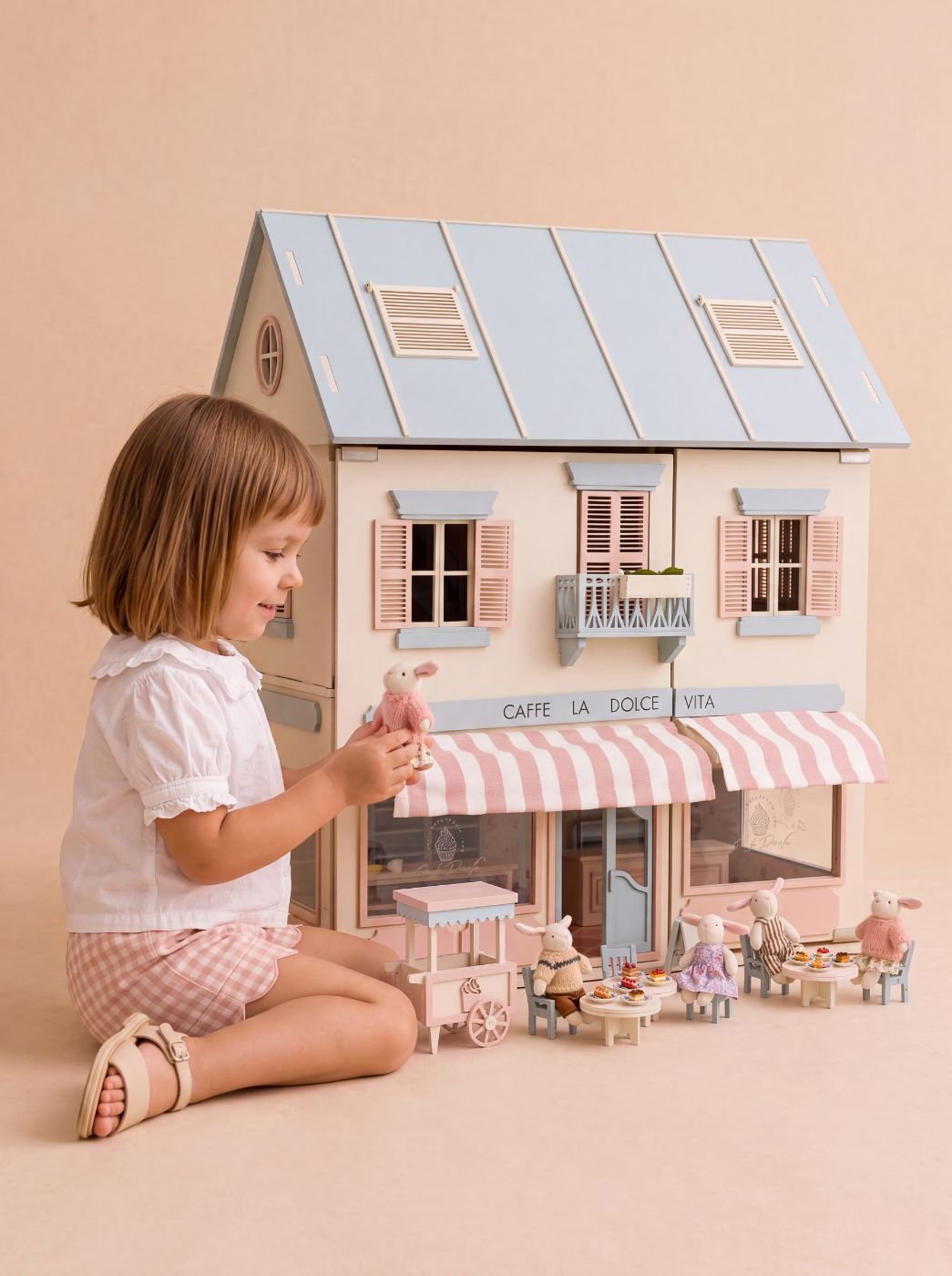
A family can cook together, argue, travel, welcome a visitor, prepare for school or simply go to bed. Children can reproduce familiar routines or invent situations they have never experienced.
Anthropomorphic characters — animals given human routines, emotions and relationships — are especially flexible because they sit between reality and fantasy.
At Little Forest Animals, families such as the Bellevue and Thompson households are designed to inhabit the miniature architecture while leaving their personalities open to the storyteller.
The characters provide the cast.
The child writes the script.
Meet the Bellevue and Thompson Families and find the characters ready to move into their next story.
11. Parents Do Not Have to Direct the Story
One of the easiest ways for adults to make play feel like work is to ask too many questions.
What colour is that? How many chairs are there? What is the rabbit doing? Can you tell me what happens next?
Those questions can be useful in some contexts, but dollhouse play does not need to become a lesson.
Sometimes the most supportive adult role is simply to notice the child's premise and join it.
If invited, follow rather than lead. Accept that the bathroom is now a bakery. Let the smallest animal drive the largest car. Do not correct the architecture of an imaginary world.
Open-ended play works because the child retains meaningful control over what happens next.
12. Repetition Is Part of the Story
Adults often look for novelty. Children frequently look for repetition.
The same family may go to bed twenty times. The same character may repeatedly lose something. Furniture may move out of a room only to return to exactly the same place.
Repetition does not mean nothing is happening.
In pretend play, familiar scenarios can be revisited with tiny variations. The story becomes known enough to manipulate.
A dollhouse supports this beautifully because the physical environment remains available from one play session to the next.
Yesterday's story can still be visible in the arrangement of the rooms.
The Real Benefit Is That There Is No Single Benefit
Perhaps the most useful way to think about the benefits of dollhouse play is to stop looking for one dramatic outcome.
A dollhouse is simultaneously a place for imaginative play, open-ended play, role play, storytelling, object manipulation and — when children play together — shared negotiation.
Research gives us good reasons to be interested in those experiences, but not good reasons to claim that a dollhouse guarantees intelligence, empathy, attention or any other developmental result.
That is not a weakness.
It is a more respectful view of play.
A child does not have to be improving a measurable skill every minute for play to be worthwhile.
Sometimes a rabbit is simply late for dinner.
And the child deciding why may be exactly enough.
Discover the Little Forest Animals world — miniature houses and characters designed to provide the setting while children decide what happens next. 
FAQ: Benefits of Dollhouse Play
What are the benefits of dollhouse play?
Dollhouse play can create opportunities for imaginative storytelling, role play, object manipulation, shared social play and sustained engagement. Research does not support presenting dollhouse or pretend play as a guaranteed cause of broad developmental improvements.
Is dollhouse play considered imaginative play?
Yes. Children commonly use dollhouses for pretend or imaginative scenarios in which characters, objects and rooms represent invented situations and stories.
Can dollhouse play support language?
Dollhouse play naturally creates opportunities for narration, dialogue and conversation. Research has found connections between pretend play and language-related abilities, but evidence does not establish pretend play as a unique cause of stronger language development.
Does dollhouse play teach empathy?
Role play can give children opportunities to imagine characters with different feelings, intentions and perspectives. It is more accurate to describe this as an opportunity for perspective-taking than to claim a dollhouse directly teaches or causes empathy.
Is dollhouse play good for fine motor skills?
Dollhouse play involves fine-motor actions such as grasping figures, positioning furniture and manipulating small objects. Without dollhouse-specific intervention evidence, it is best not to promise measurable fine-motor improvement.
Can dollhouses encourage screen-free play?
They can provide an accessible, tactile alternative to screen-based activities. Because the play is open-ended, the same house can support many different stories without a predetermined sequence.
Is pretend play proven to improve cognitive development?
The evidence is mixed and nuanced. A major research review found insufficient support for strong claims that pretend play uniquely causes broad cognitive or developmental gains. Pretend play may coexist with or provide one of several routes to certain skills, but causal claims should be made cautiously.