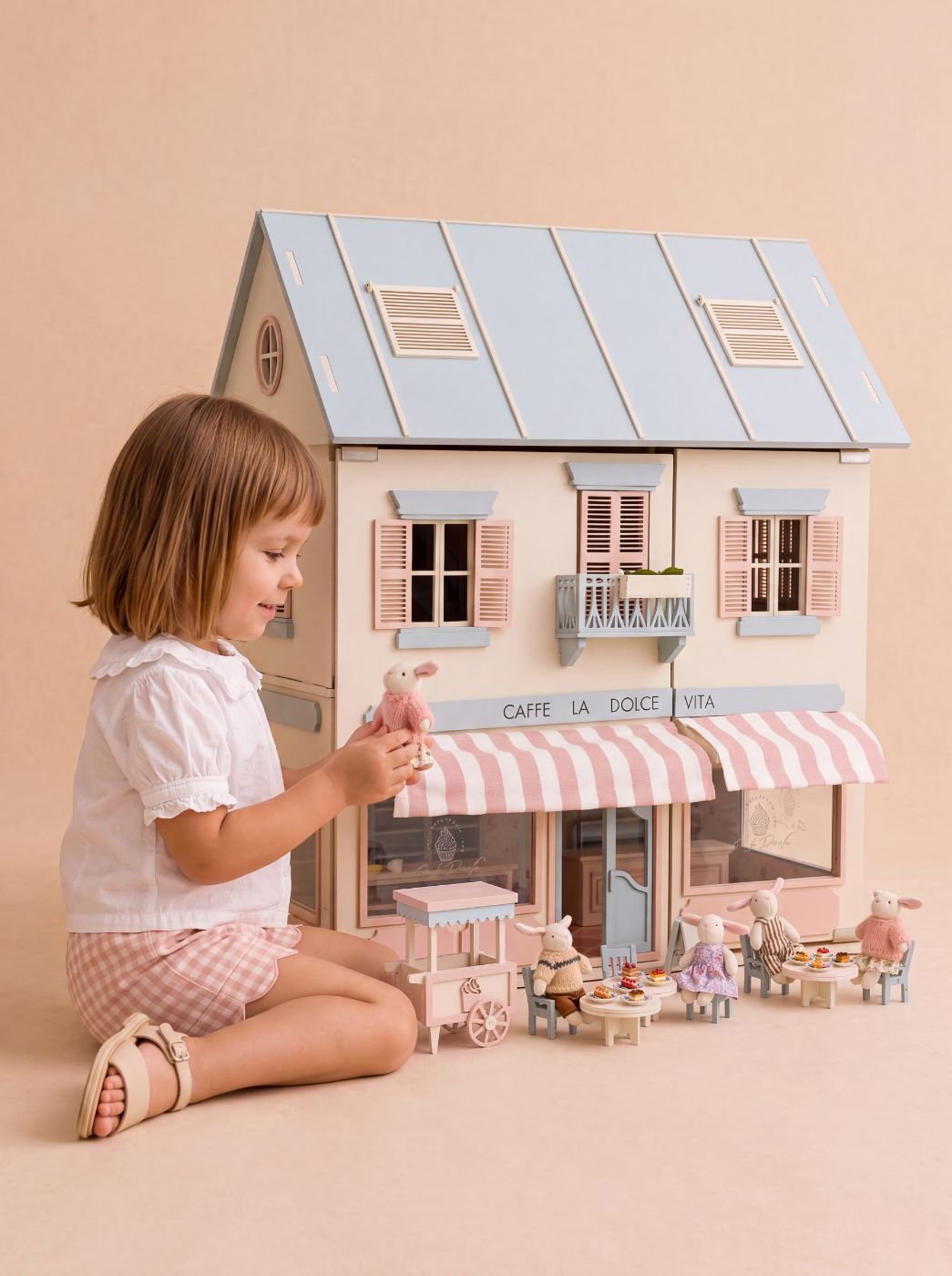

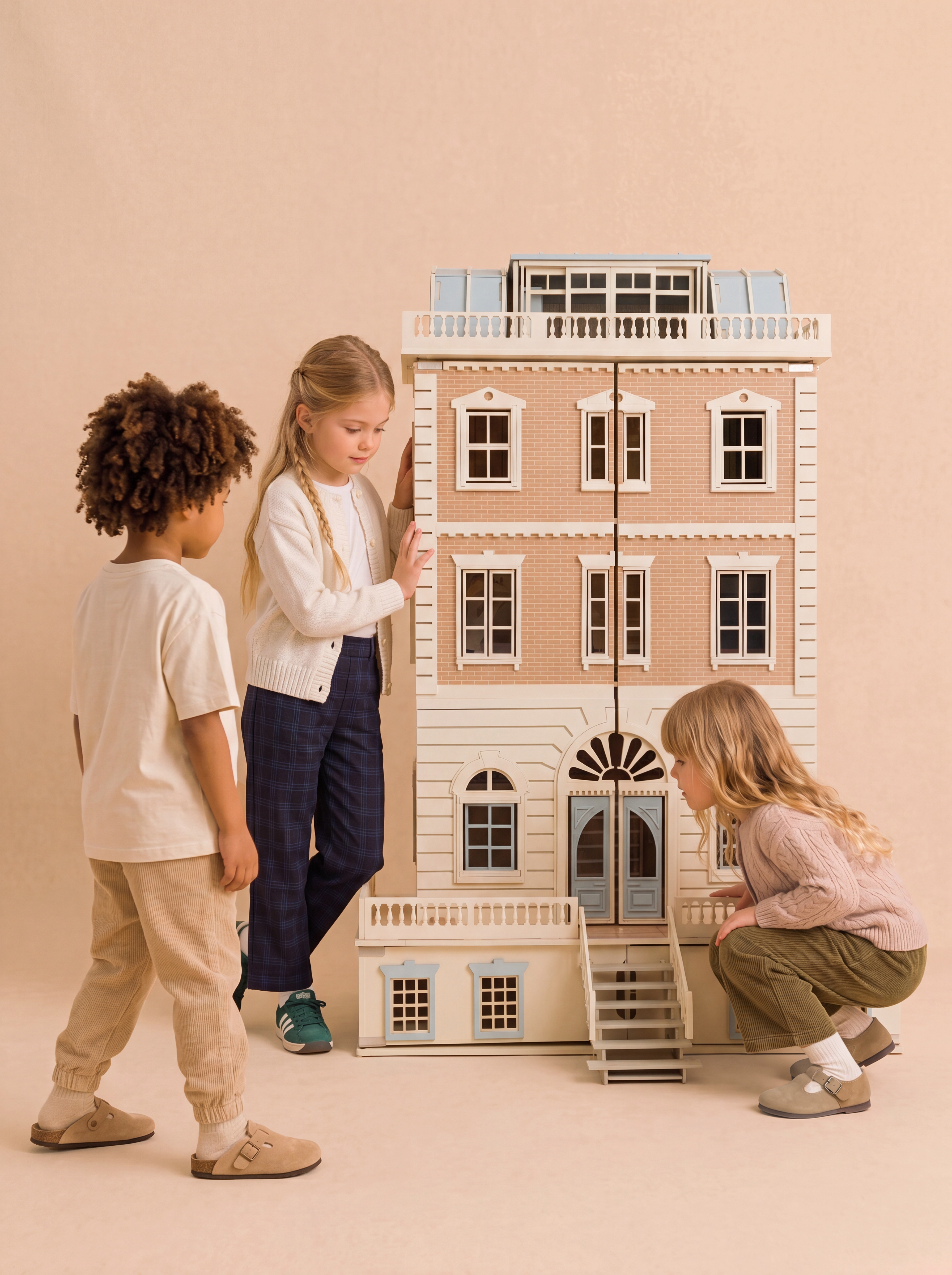
Why We Design Dollhouses Like Architecture
We do not begin by decorating a toy to make it look like a building. We begin with architecture - and reduce its scale.
That distinction explains much of the way Little Forest Animals approaches an architectural dollhouse. Before the furniture, tiny lamps, textiles and characters arrive, there is a facade, a roofline, a sequence of storeys and rooms, and a question familiar to architects at every scale: how should people move through and experience this space?
A dollhouse has to invite play, but it also has to make visual sense as a building. Windows need rhythm. Floors need proportion. Staircases need somewhere to lead. Rooms need enough difference to suggest their own purpose while still belonging to one architectural whole.
For us, architecture is not a decorative theme applied at the end.
It is where the dollhouse begins.
1. A Dollhouse Is a Building Before It Is a Room Set
When people look inside a dollhouse, attention naturally goes first to the smallest details: a miniature bed, a lamp, a table laid for tea.
But those objects only work because architecture has already created a place for them.
The shell determines the experience. The height of each storey changes the proportions of the furniture. Window placement changes how a room feels. Staircases connect stories vertically. Roof forms create spaces that could not exist on a simple rectangular box.
This is why we think about a designer dollhouse from the outside in and the inside out at the same time.
The facade has to create identity. The interior has to create possibility.
Neither works particularly well without the other.
2. Real Cities Give Us a Vocabulary
Architecture becomes memorable when it belongs to somewhere.
Little Forest Animals houses draw their identities from cities and architectural traditions rather than from one generic idea of a home. Paris, London, New York and Monaco each provide a different vocabulary of scale, facade, roof, window and vertical movement.
A Parisian reference may suggest tall proportions, repeated windows and a more formal facade. New York introduces the vertical townhouse, exterior fire escape and rooftop life. Monaco can lead toward a more ornate European mansion language.
We do not need to reproduce one real building exactly for those references to be meaningful.
The aim is interpretation rather than replica: to identify the architectural details that make a place recognisable and translate them into a miniature world.
Travel through the cities and architectural traditions that inspire the Little Forest Animals world.
 3. Why the Haussmann Facade Works So Well in Miniature
Few architectural languages translate to miniature as naturally as the Parisian Haussmann facade.
Its visual order is immediately legible: vertically aligned windows, repeated bays, elegant proportions and the distinctive roofline of the upper storeys.
House of Monaco explores this language through a six-storey Haussmann-inspired structure with a powder-blue mansard roof, arched windows and a sequence of detailed rooms.
At full scale, these elements organise a city street. In miniature, they organise the eye.
A child may not use the words facade rhythm, symmetry or mansard roof. But those relationships are still visible. Architecture can be experienced before its vocabulary is learned.
4. Proportion Matters More When Everything Is Small
Miniature scale is surprisingly unforgiving.
In a full-size room, a few centimetres can disappear. In a dollhouse, the same proportional error can make a window, staircase or piece of furniture feel immediately wrong.
That makes proportion one of the most important parts of architectural dollhouse design.
The relationship between floor height and window height matters. So does the relationship between a doorway and the figure who passes through it, or between a table and the room around it.
Many miniature environments use 1:12 as a familiar reference scale. Little Forest Animals houses and their components should always be described according to the specifications of the individual model rather than assuming that every element follows one universal miniature ratio.
What matters conceptually is consistency: architecture, furniture and characters need to feel as though they belong to the same world.
5. Storeys Create More Than Height
Adding storeys to a dollhouse does more than make it taller.
Vertical architecture changes storytelling.
A kitchen downstairs and a bedroom upstairs already create movement. Add another level and the child begins to navigate the house rather than simply arrange a room. Staircases become transitions. Landings become pauses. Attics and rooftops become destinations.
House of New York uses six storeys and eleven rooms, creating a distinctly vertical experience that reflects the urban architecture behind the design.
House of Paris uses four storeys and seven rooms to create a different rhythm, combining living spaces with imaginative commercial interiors.
The number of rooms is therefore not simply a specification. It changes the number of relationships that can exist inside the house.
 6. Architecture Gives Imagination a Framework
Open-ended play is sometimes interpreted as the absence of structure.
We see it differently.
A strong architectural framework can give imagination more places to go.
A staircase asks where someone is going. A window asks what is outside. A shopfront suggests customers. A bedroom suggests morning and night. A rooftop immediately feels different from a kitchen.
None of these details dictates the story. They create prompts.
This is one reason architectural toys for children can be so compelling: space itself becomes part of the play.
The child is not only moving characters. They are deciding where things belong, how rooms relate to one another and how a story moves through space.
7. Spatial Imagination Begins With Moving Things Around
Children rarely leave miniature interiors exactly as they find them.
Furniture migrates. Bedrooms become shops. A dining table appears on another floor. One family moves out and another moves in.
From a design perspective, this is interesting because the child is constantly making spatial decisions.
Where should the bed go? Can two chairs fit here? What happens if the living room moves upstairs? Which room feels right for a particular story?
We should be careful not to turn ordinary imaginative play into an exaggerated developmental claim. But it is fair to say that a dollhouse gives children a tangible environment in which to explore relationships between objects, rooms and movement.
That is spatial imagination in its most intuitive form.
8. The Interior Is Designed Like a Tiny Interior
Once the architectural shell is established, the work shifts inward.
A miniature interior needs hierarchy just as a full-size one does. Larger pieces establish the room. Textiles soften it. Lighting changes atmosphere. Small objects create evidence of life.
The goal is not to fill every centimetre.
Good miniature interiors need negative space too.
A room should feel detailed enough to invite close looking while remaining open enough for a child to rearrange it. This balance is one of the reasons we treat furniture and accessories as part of the architectural composition rather than as an unrelated bundle of toys.
The house is not complete because every space is full. It is complete when every space feels possible.
9. Why Architecture Makes the Dollhouse Last Visually
Children's objects often have a very clear visual age.
Architecture can soften that boundary.
A well-proportioned facade, restrained material palette and recognisable building references allow a dollhouse to remain interesting even when it is not actively being played with.
That is how an architectural toy can gradually become a design object within a room.
At one stage it is a setting for daily stories. Later, the furniture may be rearranged less often. Eventually, the house may remain because the family still enjoys looking at it.
This visual longevity is important to Little Forest Animals. We want the architecture to carry the object beyond one moment of childhood.
10. Architecture and Making Cannot Be Separated
An architectural idea only matters if it can be built.
Rooflines, openings, staircases and multi-storey structures eventually have to become physical components that align, support one another and survive use.
That is where design meets the workshop.
The process of turning drawings into wooden structure involves decisions about components, assembly, joinery, surface preparation, finishing and the integration of miniature interiors.
For a closer look at that process, see our behind-the-scenes guide to how a Little Forest Animals dollhouse is made.
11. A Small Introduction to a Very Large Subject
Architecture is one of the largest creative disciplines humans have invented. It shapes streets, cities and the rooms in which everyday life happens.
A dollhouse makes that enormous subject small enough to hold.
Children do not need to know the history of Haussmann's Paris to notice a beautiful facade. They do not need to understand architectural sections to recognise that one room sits above another. They do not need a lesson in circulation to send a character up a staircase and onto a roof.
Architectural toys can introduce those relationships quietly.
Not as a curriculum.
As part of play.
Why We Keep Returning to Cities
Cities contain layers of architecture that already carry stories.
A Paris facade suggests one kind of life. A New York townhouse suggests another. London, Rome, Nice and Monaco each offer different proportions, colours, rooflines and cultural associations.
That makes cities natural starting points for miniature architecture.
Each house can belong to the same Little Forest Animals world while retaining its own identity.
The result is not a collection of identical houses wearing different colours. The ambition is a collection in which architecture changes the character of each miniature world.
The House Is Only the Beginning
When a Little Forest Animals house is finished, architecture has done its first job.
It has established scale, rhythm, rooms, movement and place.
Then the child takes over.
A bedroom becomes something else. Furniture moves. Animal families arrive. A rooftop acquires an entirely new purpose. The building begins to collect stories that were never present in the original drawings.
That is why we design dollhouses like architecture.
Not because we want children to preserve them exactly as we designed them.
But because good architecture creates a framework strong enough for life to happen inside it.
Even when that life is only 1:12 the size.
FAQ: Architectural Dollhouses
What is an architectural dollhouse?
An architectural dollhouse is designed with particular attention to building form, proportion, facade, storeys, rooms and spatial relationships rather than treating the house only as a container for miniature furniture.
Why does proportion matter in a dollhouse?
Because small-scale differences are visually noticeable. Window heights, room dimensions, staircases, furniture and figures need to relate convincingly to one another for the miniature environment to feel coherent.
Are Little Forest Animals dollhouses based on real buildings?
The houses draw inspiration from cities and architectural traditions rather than functioning as exact replicas of a single building. References can include Parisian and Haussmann-style facades, urban townhouses, mansard roofs and other recognisable architectural elements.
What are architectural toys for children?
Architectural toys are play objects that engage with buildings, construction, rooms, scale or spatial relationships. They can range from building systems to detailed dollhouses and miniature environments.
Can a dollhouse encourage spatial imagination?
A dollhouse gives children a physical setting in which they can move furniture, navigate rooms, connect floors and invent different uses for spaces. It provides a tangible framework for exploring spatial relationships through play.
Why are multi-storey dollhouses useful for storytelling?
Different floors create destinations and transitions. Kitchens, bedrooms, shops, staircases, attics and rooftops can each support different scenes, allowing stories to move through the building rather than remain in one room.