
How a Little Forest Animals Dollhouse Is Made
A finished dollhouse can make the process behind it almost invisible.
By the time the roof is in place, the rooms are furnished and the smallest objects have found their positions, it is easy to see only the miniature world in front of you. But every Little Forest Animals handmade dollhouse begins much earlier - with an idea, an architectural drawing and a long sequence of decisions made at full scale.
Making a house means moving repeatedly between two worlds: architecture and play. Proportions have to feel convincing. Openings have to work. Surfaces need to be finished carefully. Furniture, textiles and miniature objects have to belong to the same visual language.
The result may be miniature, but the process is not.
This is a look behind the scenes at how a Little Forest Animals house moves from an idea to a finished home.
1. Every House Begins With Architecture
Before there is furniture, paint or a miniature tea cup, there is the house itself.
Little Forest Animals began with an interest in architecture and with a dollhouse originally created as a personal project. That architectural starting point still shapes the way each new model is approached.
A city, building type or architectural memory may establish the first visual language: a mansard roof, a townhouse façade, tall windows, a fire escape or the proportions of a particular kind of home.
From there, the exterior and interior have to work together. Floor heights, staircases, windows, doors and room dimensions are considered not simply as decoration, but as parts of a small building children will actually interact with.
This is where a handcrafted dollhouse differs from a flat decorative façade. The architecture has to survive being opened, furnished, rearranged and returned to again and again.

2. From Drawing to Wooden Structure
Once the design is established, the house has to become a physical structure.
Wooden panels and components are prepared according to the dimensions of the model. Openings for windows and doors, floor plates, walls, roof elements and architectural details all need to align before the house can begin to take shape.
Joinery is one of the quiet parts of the process. When it works well, the person looking at the finished house notices the architecture rather than the way it is held together.
That is particularly important at dollhouse scale. A few millimetres can affect the alignment of a façade, staircase or roofline in a way that would be almost invisible on a full-size building.
The aim is not simply to assemble pieces of wood. It is to create a stable architectural framework for everything that follows.
3. Sanding and Finishing: The Work You Feel More Than See
Much of the labour in an artisan dollhouse happens in stages that are deliberately difficult to notice when the house is complete.
Sanding and surface preparation are among them.
Edges, panels and architectural components need to feel considered in the hand as well as look clean to the eye. Surface preparation also affects the way later finishes sit on the material.
This is slow work precisely because the finished result should feel effortless.
After preparation, painted and finished surfaces establish the character of each model. Little Forest Animals' material and finish choices are intended for children's products; exact paint specifications and compliance language should always follow the current product documentation for the relevant model and market.
Why Wood Matters: The Material Behind a Beautiful Dollhouse
The important point from a making perspective is that finishing is not one decorative gesture at the end. It is part of a sequence of preparation, application, drying, inspection and correction.
4. The Exterior Gets Its Character
Once the basic structure exists, architectural identity begins to appear.
Windows, doors, rooflines, trims and façade details turn a wooden framework into a recognisable house.
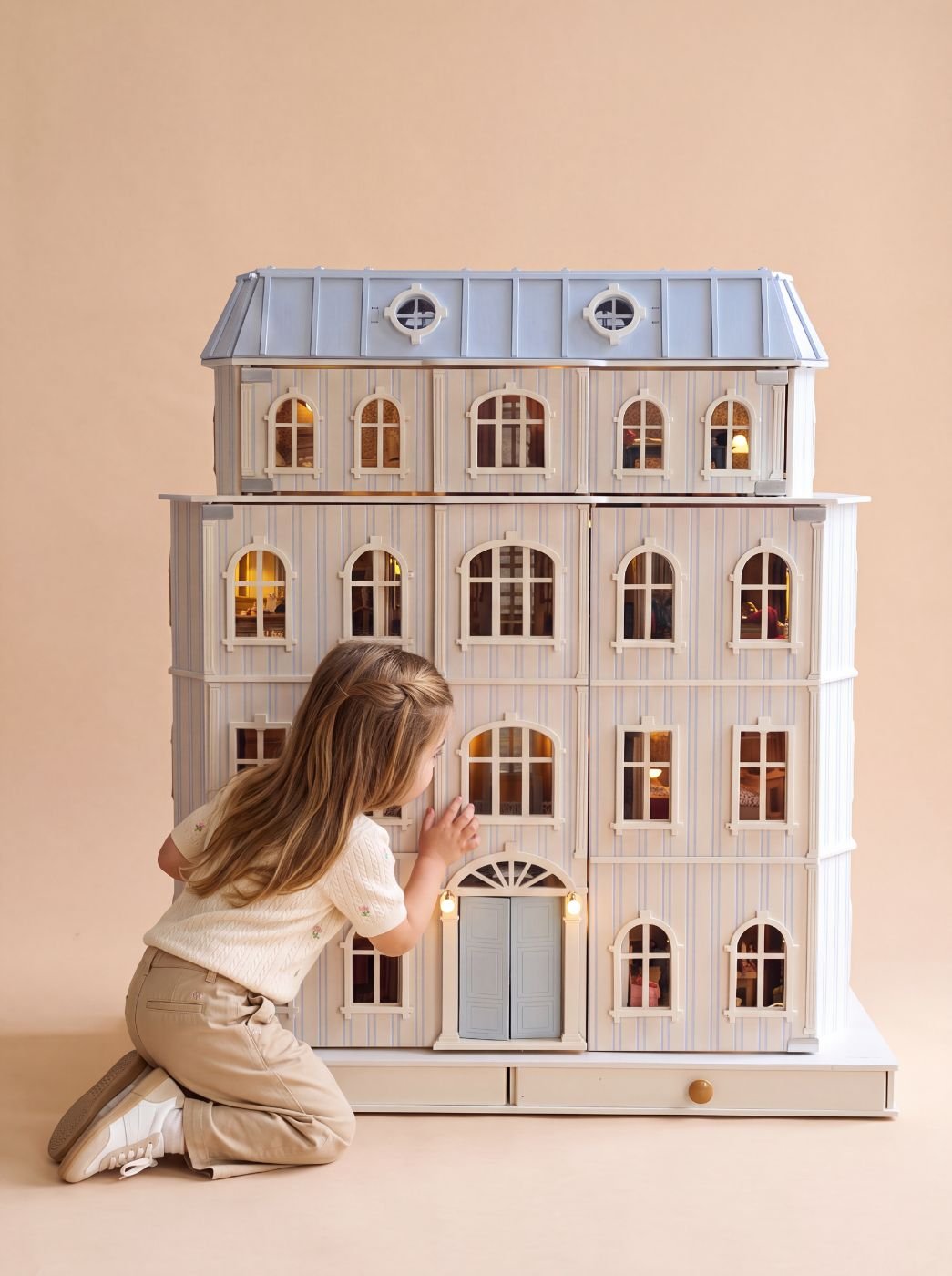
Different Little Forest Animals models use architecture in very different ways. House of Paris draws on a tall urban façade; House of Monaco takes cues from Haussmann architecture and a mansard roof; House of New York introduces the vertical rhythm and fire-escape language of a city townhouse.
These references are not intended as miniature replicas of one exact building. They are interpretations - enough architectural vocabulary to suggest a place while leaving room for imagination.
At this stage, the house begins to look finished from the outside.
Inside, however, another workshop is only beginning.
5. Making the Miniature Interiors
A Little Forest Animals house is not designed as an empty shell waiting for furniture to be purchased separately.
The miniature interiors are part of the identity of the house.
Beds, tables, seating, cabinetry and smaller objects are selected and arranged so that individual rooms feel distinct while still belonging to the same home. At miniature scale, proportion becomes particularly noticeable: a chair that is slightly too large or a table positioned incorrectly can change the feeling of an entire room.
This is why furnishing a dollhouse is closer to styling a small interior than filling a toy box.
Every room needs enough detail to suggest a story, but enough space for a child to change that story.
6. Textiles Bring Softness to the Architecture
Wood gives the house its structure. Textiles make the miniature rooms feel inhabited.
Bedding, cushions, rugs and other textile elements soften the geometry of the architecture and introduce pattern, texture and scale.
Textile sets are especially important because they create contrast with hard surfaces. A tiny bed feels different once it is dressed. A living room changes when fabric, rugs and cushions are introduced.
The same principle applies at full scale: textiles are often what turn architecture into a home.
In miniature, the effect is simply concentrated.
7. The Smallest Objects Often Create the Biggest Stories
The closer someone gets to a dollhouse, the more the small details begin to matter.
A miniature cup on a table can suggest breakfast. A book beside a bed can imply that someone has just left the room. A tiny lamp changes the mood of an entire floor.
Little Forest Animals houses may include detailed accessories such as miniature tableware and, depending on the model or collection, porcelain-style tea-set elements and other small decorative objects.
These pieces are not included simply to increase the number of accessories. Their purpose is narrative.
A room becomes easier to imagine when it contains evidence that somebody lives there.
That is why the smallest objects can sometimes do more storytelling work than the largest pieces of furniture.
8. Lighting Changes the House Again
Lighting adds another layer to the miniature architecture.
During the day, windows, colours and furniture define the rooms. When miniature lighting is introduced, shadows and depth become more noticeable and the house takes on a different presence.
Little Forest Animals offers lighting options for its dollhouses, allowing rooms to be illuminated without turning the house into a permanently wired object.
For the maker, this means lighting has to be considered alongside the architecture rather than treated as an unrelated accessory.
The position of light changes how a staircase, window or room is perceived. In miniature, a small source can transform an entire floor.
Our lighting collection.
9. Assembly Is Followed by Quality Control
A house is not finished simply because all of its parts are present.
Before a completed dollhouse leaves the production process, the structure and visible finish need to be checked. Alignment, surfaces, components and the completeness of the relevant furniture and accessory set are part of that final review.
Quality control is particularly important with handcrafted production because making by hand naturally introduces small variations.
The objective is not industrial sameness. It is consistency where consistency matters - structure, function, finish and completeness - while preserving the character of an object that has passed through human hands.
If a precise public QC checklist is required for publication, it should be verified against the current Little Forest Animals workshop procedure rather than inferred.
10. How Many Hours Does a Handmade Dollhouse Take?
This is one of the most natural questions to ask - and one of the hardest to answer with a single number.
Different houses vary substantially in size, architecture, number of rooms, furniture and finishing requirements. Production also happens in stages, with different makers and processes contributing at different points.
For that reason, it is more accurate to think in terms of accumulated craft rather than one person working continuously from beginning to end.
Design, preparation, cutting, joinery, sanding, finishing, painting, miniature furniture, textiles, assembly and quality control all contribute time to the finished object.
Little Forest Animals should publish a specific hours-per-house figure only when that number has been measured and verified for the model concerned.
The important distinction is that a handmade dollhouse is not created in one automated step. It is the result of many separate operations gradually becoming one object.
11. Why Handcraft Still Matters
Efficiency is valuable in manufacturing. But not every object benefits from having all evidence of the maker removed.
Small variations in hand-finished details can give an artisan dollhouse character. They remind us that the object has moved through a workshop rather than appearing fully formed from a machine.
That does not mean precision is unimportant. The opposite is true. Handcraft is most convincing when technical accuracy and human character coexist.
For Little Forest Animals, the objective is a house robust enough for play, detailed enough to reward close looking and beautiful enough to remain part of a room after play has ended.
That combination is difficult to achieve through architecture alone. It depends on all of the quieter stages behind it.
From Workshop to Home
At the end of the process, the scale changes again.
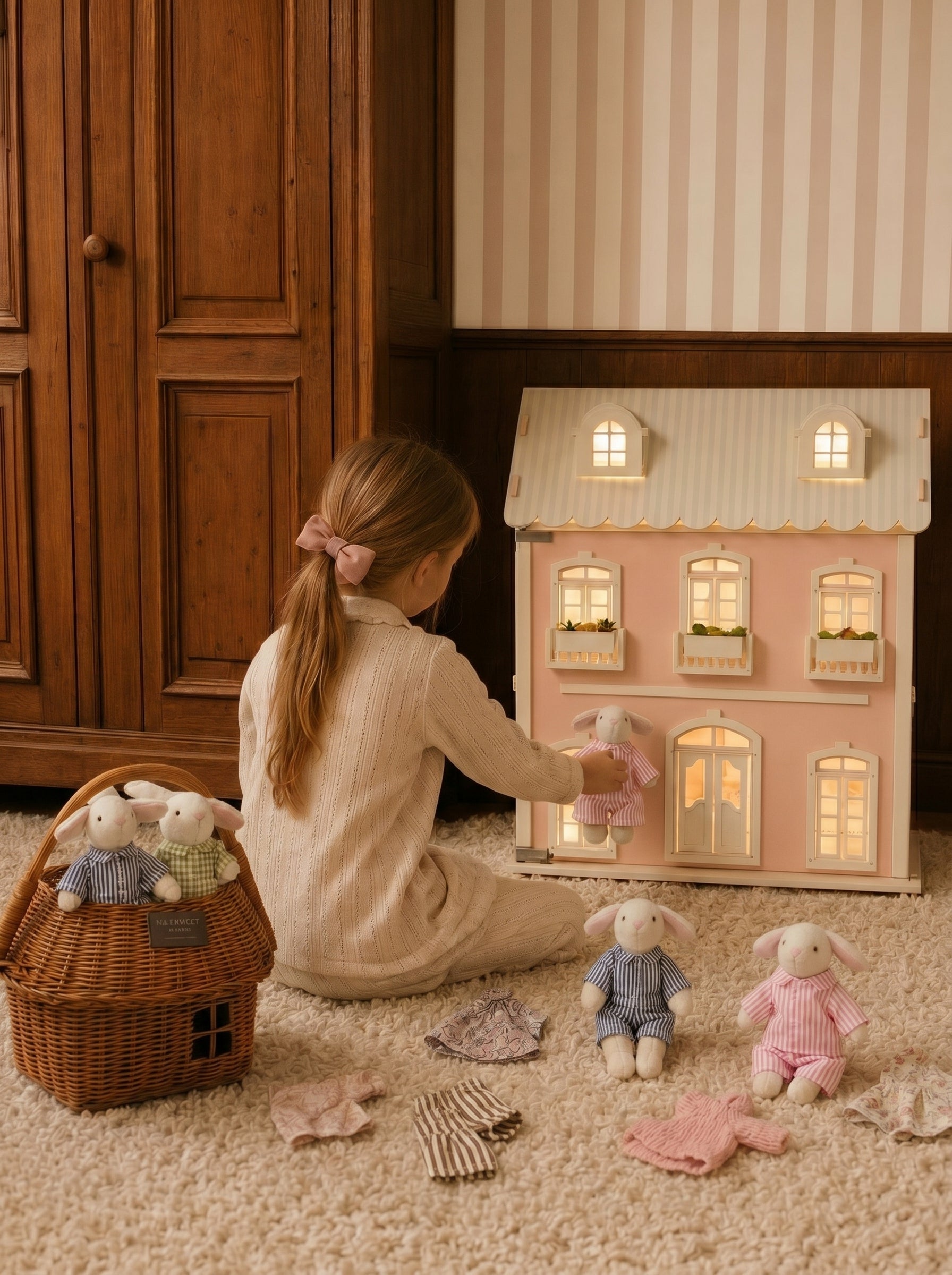
The house leaves the workshop as a finished object and enters a real home. The carefully arranged rooms are rearranged. Furniture moves. Animal families arrive. A child decides that the kitchen belongs upstairs or that a bedroom should become a shop.
That is not the end of the design process.
It is the reason for it.
A handmade dollhouse is built with precision so that imagination does not have to be precise at all.
The joinery, sanding, finishing, textiles, furniture, miniature objects and final checks create the framework. What happens next belongs to the family who receives it.
And that is how a Little Forest Animals house is truly finished: not in the workshop, but when somebody begins to tell a story inside it.
FAQ: How Handmade Dollhouses Are Made
How are handmade dollhouses made?
The process typically moves through architectural design, preparation of wooden components, cutting and joinery, sanding and finishing, painting, interior furnishing, textile details, assembly and quality control. The exact sequence can vary by model.
What makes a dollhouse handcrafted?
A handcrafted dollhouse involves meaningful hands-on work across its production, finishing or detailing rather than being produced as a single automated object. Small natural variations can be part of its character.
What materials are used in a Little Forest Animals dollhouse?
Materials vary by model and component. Little Forest Animals uses wood as the architectural foundation of its houses, alongside textiles and miniature decorative materials. Current specifications should always be checked on the relevant product page or materials documentation.
How long does it take to make a handmade dollhouse?
There is no single verified production time that applies to every Little Forest Animals model. Larger and more detailed houses require different stages and amounts of work. A precise hours-per-house figure should be published only after workshop measurement.
Why are miniature interiors important?
Miniature interiors turn the architectural shell into a setting for storytelling. Furniture, textiles, lighting and small objects give rooms identity while leaving children free to rearrange them.
Does a handmade dollhouse need quality control?
Yes. Structure, alignment, visible finishes, components and completeness need to be reviewed before a finished house is ready to leave production.